Overview
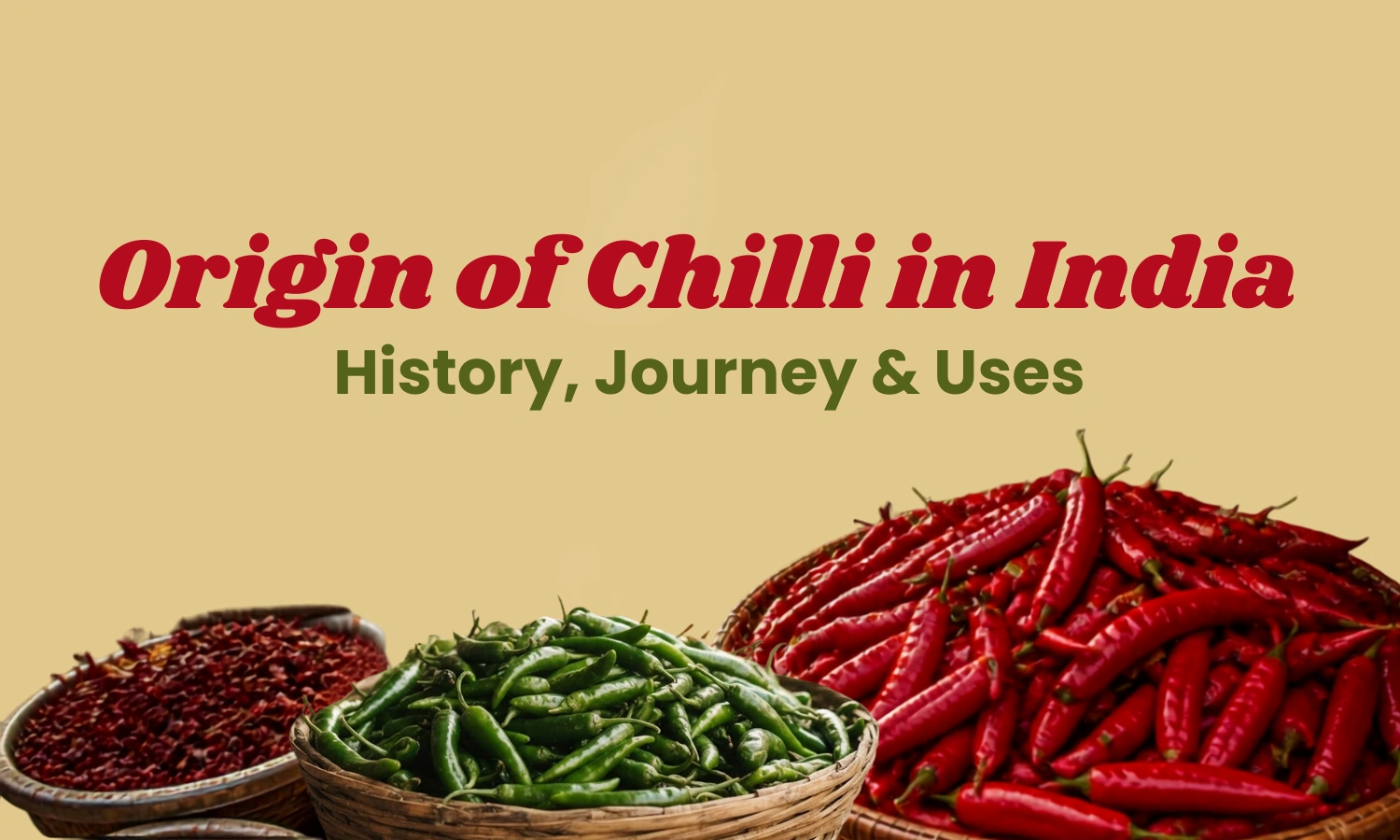
The origin of chilli in India traces back to the late 15th century, when Portuguese traders introduced the plant from South America to the Malabar coast. Before this, Indian cuisine relied on black pepper for heat. Within a few generations, chilli spread across the subcontinent and became a defining part of regional cooking, farming, and trade.
A Fruit That Traveled Across Oceans & Transformed Global Cuisine
Long before chilli touched Indian soil, it grew wild in the highlands of present-day Bolivia and Mexico. Communities there had cultivated it for thousands of years, using it in food, medicine, and ritual. The origin of chilli as a domesticated crop is generally placed in Central and South America, where archaeological evidence points to its use going back several millennia.
The plant reached the rest of the world only after European contact with the Americas. Christopher Columbus encountered chilli peppers in the Caribbean in 1492 and carried samples back to Spain, mistaking them for a variant of black pepper because of their sharp bite. This mistaken identity gave the plant its lasting name in many languages.
How the Spicy Chilli Arrived on Indian Shores?
Here’s how red chilli arrived in Indian food culture:
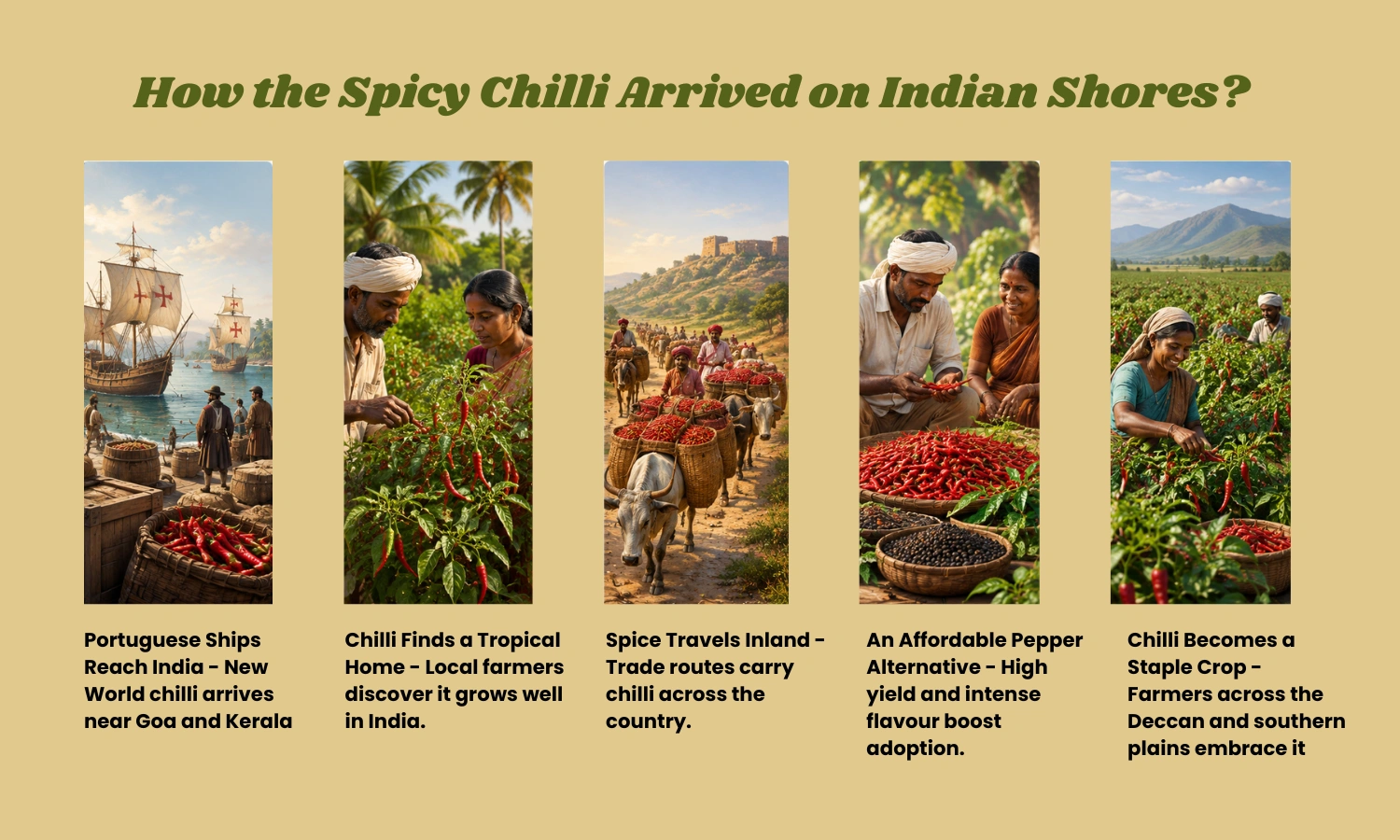
- The origin of red chilli in Indian food culture is closely tied to Portuguese maritime trade. When Vasco da Gama opened the sea route to India in 1498, Portuguese ships later carried New World crops, including chilli, to the western coast near Goa and Kerala.
- Local farmers found that the plant grew well in India’s tropical climate and required far less care than pepper vines.
- Within decades, chilli had moved inland along trade routes. Its ability to grow in varied soil, its high yield, and its intense flavour made it an easy replacement for the more expensive and slower-growing black pepper.
- This shift marks a key point in the history of chilli in India, as farmers across the Deccan and southern plains began adopting it as a staple crop.
What Is the Scientific Name of Chilli?
Scientists firmly placed the chilli plant within the nightshade family, Solanaceae, under the genus Capsicum. Most Indian chillies belong to the species Capsicum annuum, though some fiery regional varieties belong to Capsicum frutescens. The plant produces a compound called capsaicin, which is responsible for its heat and is measured on the Scoville scale.
Understanding where the word chilli comes from helps explain some of the confusion around naming. The word is believed to originate from the Nahuatl language spoken by the Aztecs, who called the fruit “chilli.” Spanish colonizers adapted this into “chile,” which later became “chilli” or “chili” depending on regional spelling conventions.
Regional Growth and the Spread Across India
The origin and distribution of chilli across Indian states did not happen evenly. Coastal regions such as Goa, Karnataka, and Andhra Pradesh adopted it first because of direct Portuguese contact. From there, it moved east into Tamil Nadu and north into Maharashtra and Gujarat through internal trade networks.
Andhra Pradesh, particularly the Guntur belt, eventually became one of the largest chilli-growing regions in the country, widely renowned for producing the vibrant red chilli powder that defines Indian cooking. Other pockets developed their own signature varieties, each suited to local soil and climate. This regional diversification is a major reason India today grows and consumes a wide range of chilli types, from mild Kashmiri chilli to intensely hot Naga chillies from the northeast.
How Chilli Became a Staple of Indian Cuisine?
The origin place of chilli as a cultivated crop was thousands of kilometres away from India, yet within a few centuries, it became so deeply woven into Indian food that many assume it always belonged here. Dishes once flavoured primarily with black pepper, tamarind, and local herbs began incorporating chilli for its sharper, more immediate heat.
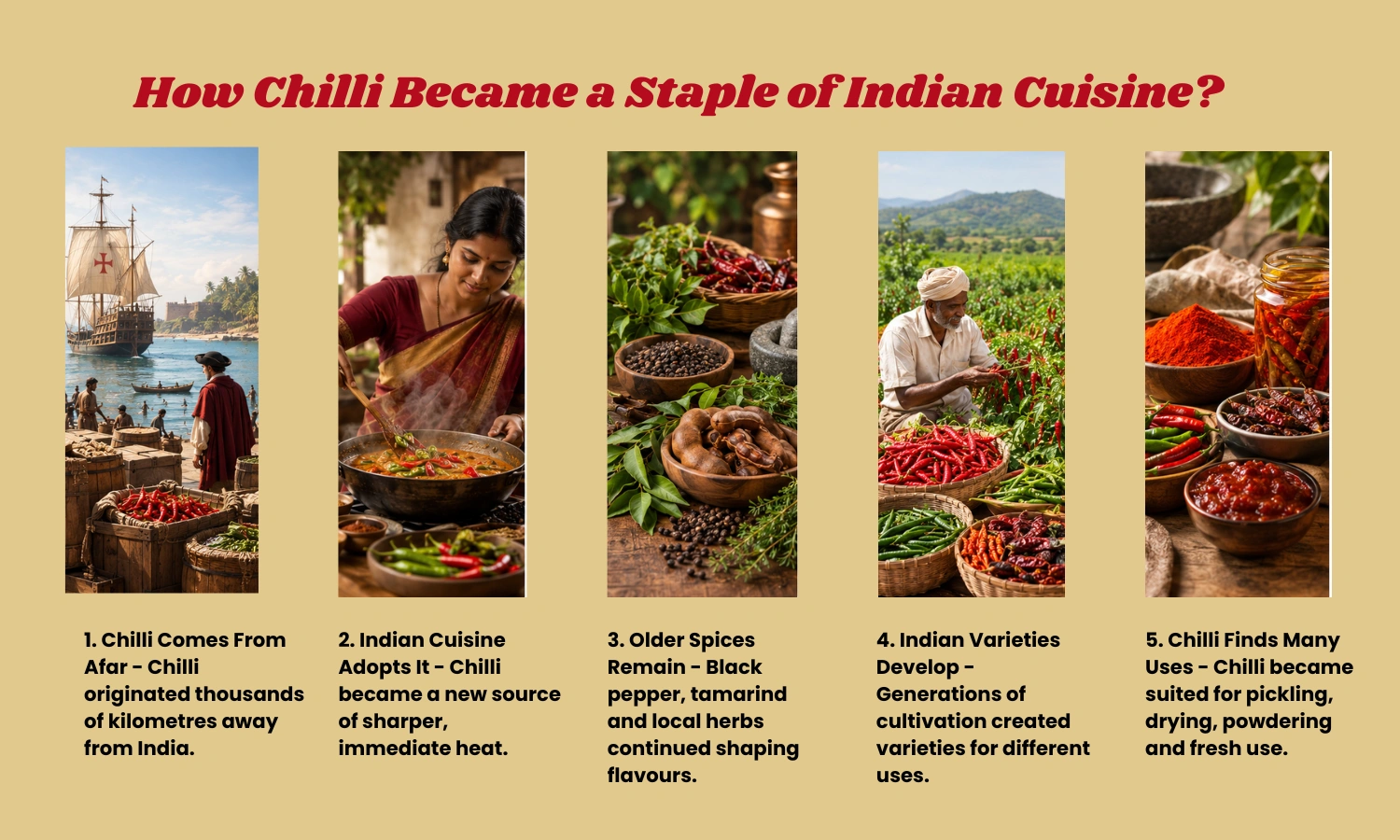
Understanding where chilli originated also clarifies why South American cuisines and Indian cuisines share a common ancestor ingredient despite having completely different culinary traditions. The plant adapted to Indian tastes through selective cultivation over generations, giving rise to varieties tailored for pickling, drying, powdering, and fresh use.
The Remarkable Impact of Chilli Beyond the Kitchen
While food remains its primary use, chilli’s journey also touches other applications. Enthusiasts often ask where chilli oil originate, and while chilli oil as a specific preparation has strong roots in Chinese cuisine, India developed its own oil-based chilli preparations independently, often infused with mustard oil or sesame oil for tempering and pickling.
The origin of chilli dish traditions in India shows remarkable variety. South Indian households use chilli in tempering, chutneys, and sambar, while modern kitchens across the country also pair regional snacks with green chilli sauce. North Indian kitchens rely heavily on chilli for rich curries and masalas. Each region built its own culinary identity around the same imported plant, using local techniques passed down through generations.
Why This History Matters Today?
Knowing the chilli origin place and its journey helps explain why quality and sourcing matter so much when choosing chilli powder or whole dry chilli for daily cooking. A crop with such a rich and layered past deserves ingredients that are grown, dried, and processed with care, not rushed through industrial shortcuts that dull flavour and heat.
Ready to Taste the Legacy?
Every packet of chilli powder carries centuries of trade routes, farming traditions, and regional craftsmanship behind it. 777 Foods sources its chillies from trusted growing belts across South India and processes them using methods that protect natural colour, aroma, and heat.
Explore the range of chilli powders and cooking essentials from 777 Foods and bring a piece of this long culinary journey into your own kitchen.
Key Takeaways
- Chilli originated in Central and South America and reached India through Portuguese traders around 1498.
- The plant belongs to the Capsicum genus within the Solanaceae family, with capsaicin responsible for its heat.
- India's coastal regions adopted chilli first before it spread inland across the subcontinent.
- Regional cultivation created distinct Indian chilli varieties suited to different climates and culinary styles.
- Chilli's history explains why sourcing quality matters when buying chilli powder or whole dried chilli today.
FAQs
What is the true origin of chilli in India?
Chilli is not native to India. Its origin traces to Central and South America, and it reached Indian shores through Portuguese traders in the late fifteenth century. Farmers on the western coast were among the first in India to cultivate it, and from there it spread across the country over several generations.
How did chilli become so central to Indian cooking?
Chilli offered a stronger, more affordable heat compared to black pepper, which was expensive and slow to cultivate. Farmers found it easy to grow in varied conditions, which encouraged rapid adoption across regions. Over time, cooks incorporated it into curries, chutneys, pickles, and spice blends, making it a kitchen essential.
Which Indian region grew chilli first?
Coastal areas near Goa and Kerala are widely credited as the earliest points of chilli cultivation in India, largely due to their direct trade contact with Portuguese ships. From these coastal belts, cultivation gradually expanded into the Deccan plateau and further inland.
Is chilli related to black pepper?
No. Chilli and black pepper come from entirely different plant families. Chilli belongs to the Capsicum genus in the Solanaceae family, while black pepper belongs to the Piperaceae family. They were confused historically only because early European traders were searching for pepper and applied the name loosely to the new fiery fruit.