Enjoy FREE SHIPPING on orders ₹300 and above! Track your orders easily by clicking here: My Account > Orders > Track Now Get 25% Off On Your 1st Order: Shop Now Enjoy FREE SHIPPING on orders ₹300 and above! Track your orders easily by clicking here: My Account > Orders > Track Now Get 25% Off On Your 1st Order: Shop Now
Best Sellers You’ll Love
sgr777foodssgr777foodssgr777foods
+91 44 48506487
sgr777foodssgr777foodssgr777foods
Cart: 0 - 0.00

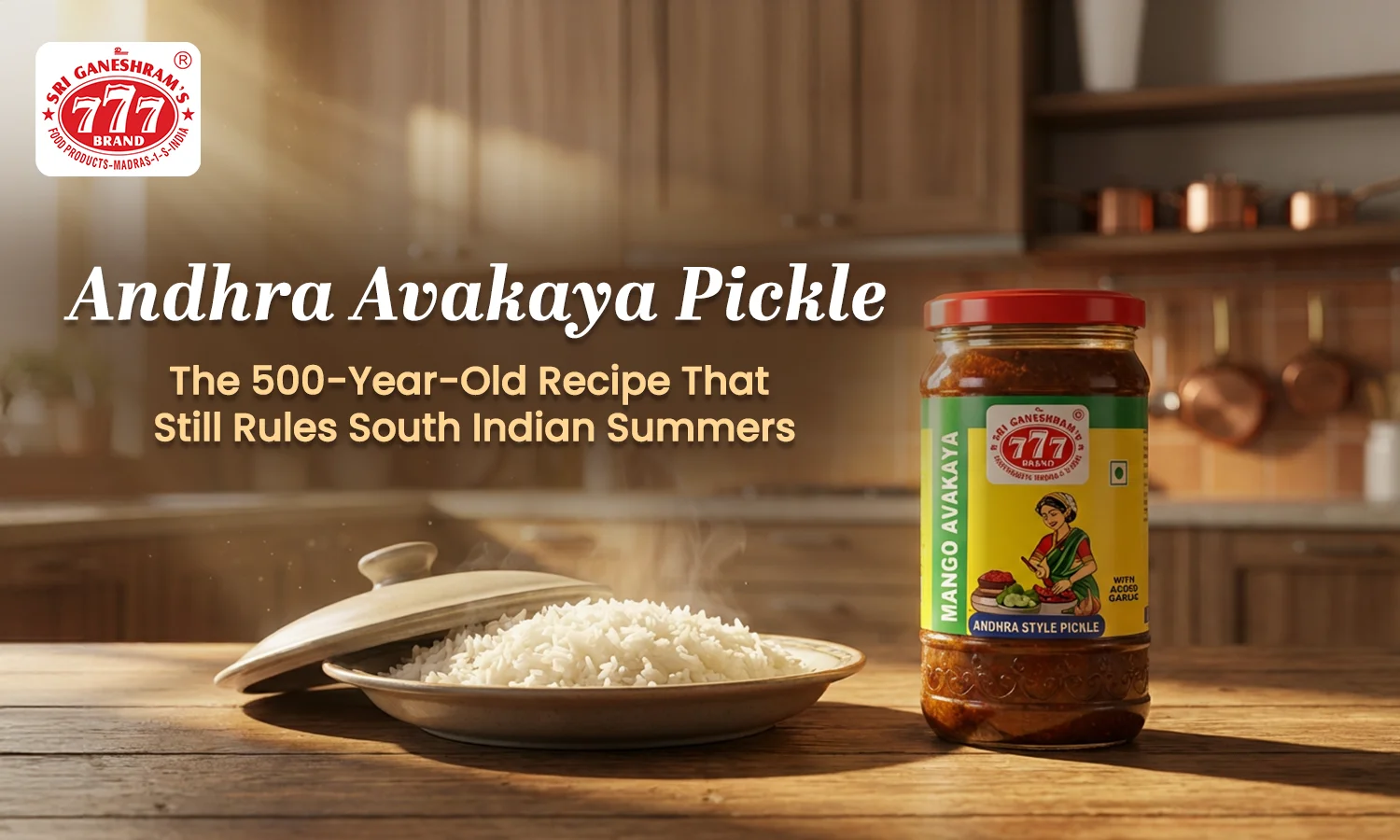
Andhra Avakaya Pickle: The 500-Year-Old Recipe That Still Rules South Indian Summers

  • 777 FOODS
  • Blog
  • Pickle
  • Andhra Avakaya Pickle: The 500-Year-Old Recipe That Still Rules South Indian Summers
Andhra Avakaya Pickle

Andhra Avakaya Pickle: The 500-Year-Old Recipe That Still Rules South Indian Summers

Introduction :

Ask any Telugu-speaking South Indian to name the one pickle that represents their kitchen, and the answer will be instant: avakaya. Not mango thokku, not gongura, not lime.

Andhra Avakaya pickle, raw mango split with the stone, layered with mustard, red chilli, fenugreek, and gingelly oil, has held its place at the centre of Andhra and Telangana dining for close to five centuries. It is possibly the oldest continuous recipe still made in Indian homes without meaningful modification.

The spelling varies by region, avakaya, avakkai pickle, aavakaya, but the recipe does not. That consistency is the point. A pickle that has survived 500 years without being reformulated is telling you something about what good food actually is.

Why Avakaya Has Outlived Every Food Trend Thrown at It
Three reasons explain the longevity of this delicious pickle. First, the ingredient stack is built for Indian summers. Raw mango peaks in April–May, mustard is a natural preservative, and gingelly oil resists rancidity at 40°C. Second, the process is forgiving: a household cook in 1525 and a production line in 2025 use the same seven ingredients in more or less the same ratio.
Third, the pickle improves with age. A freshly made Andhra avakaya pickle is good at one week, excellent at one month, and transcendent at six months. Almost no other Indian food product has that kind of maturation curve.
This is why the Andhra Avakaya Pickle 300g from SGR 777 Foods is made in strict seasonal batches every April and May. The mango is sourced from Krishnagiri and Salem, the mustard is single-origin Guntur, and the oil is chekku-pressed gingelly, the same ingredient stack a Krishna-district family would have used 200 years ago.
Avakaya vs Avakkai vs Usirikaya

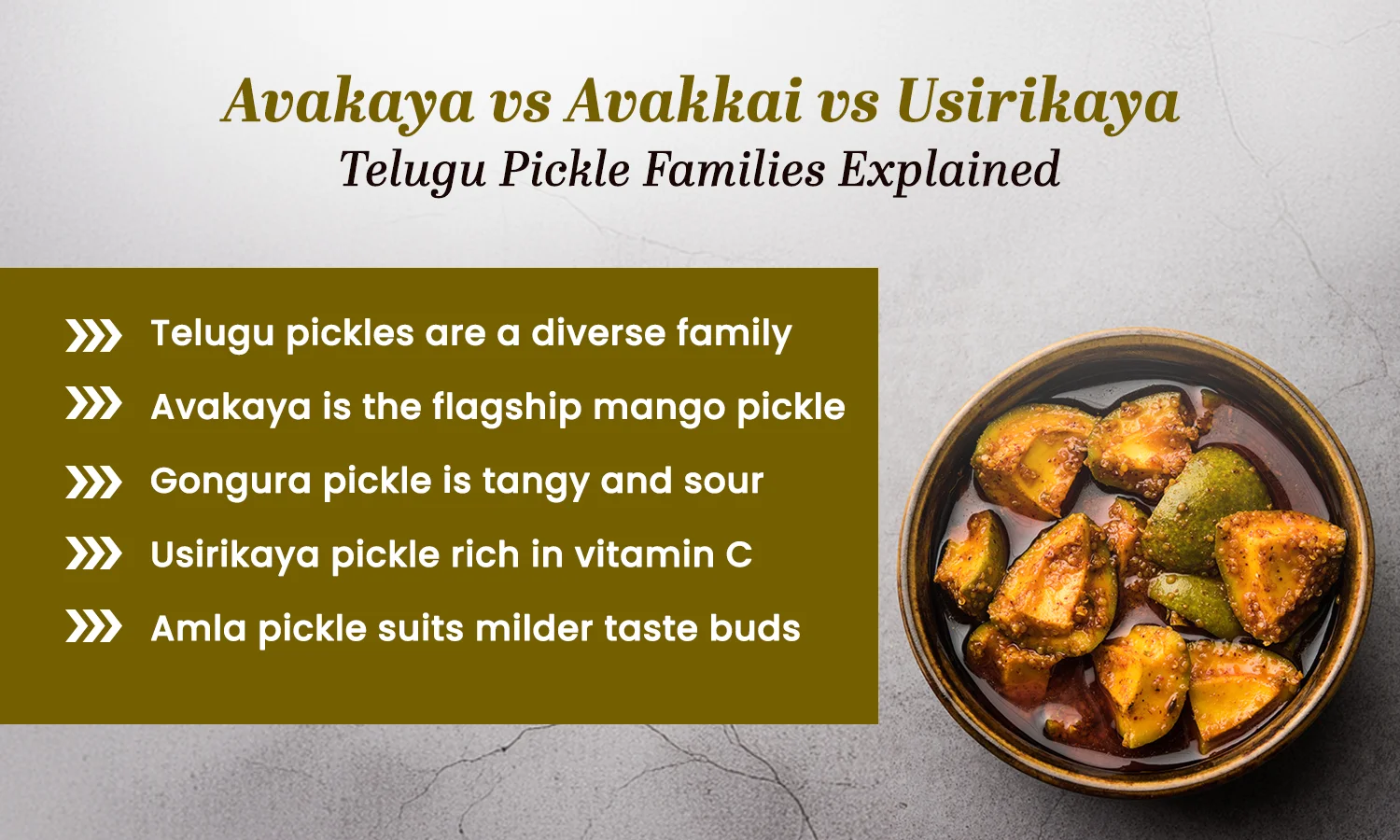
Avakaya vs Avakkai vs Usirikaya: Telugu Pickle Families Explained

The Telugu pickle tradition is not a single dish but a family. The three most recognised members:
For shoppers exploring Telugu pickles or Andhra pickles for the first time, starting with avakaya is tradition, but the Amla Pickle 300g (usirikaya style) is often easier on palates unaccustomed to bold Andhra heat. It also happens to be one of the most nutritionally dense pickles in the SGR 777 range. Amla pickle benefits are well-documented in Ayurvedic and modern nutritional literature alike, with a single tablespoon delivering measurable vitamin C even after the pickling process.

How to Tell a Real Avakaya from a Commodity One

The market for Andhra avakaya pickle online has expanded fast, and quality has become uneven. Four markers separate the real thing from the imitation:

1. Oil layer. A genuine avakaya pickle sits under a visible gingelly oil layer, not a refined-oil film.
2. Mustard texture. You should see split mustard seeds, not ground paste. The split seed releases flavour over months; ground mustard peaks early and fades.
3. Chilli colour. Guntur-grade red chilli produces a deep crimson. Commodity chilli tends toward brick-orange.
4. Maturation time. A label that says “best after 15 days” is honest. Pickles marketed as ready-on-day-one have been acid-shortcutted.
The same markers apply when buying avakaya pickle online from any brand. SGR 777 prints the packing date and the recommended maturation window on every jar.
SGR 777's Andhra Pickle

Why SGR 777's Andhra Pickle Range Holds Its Ground

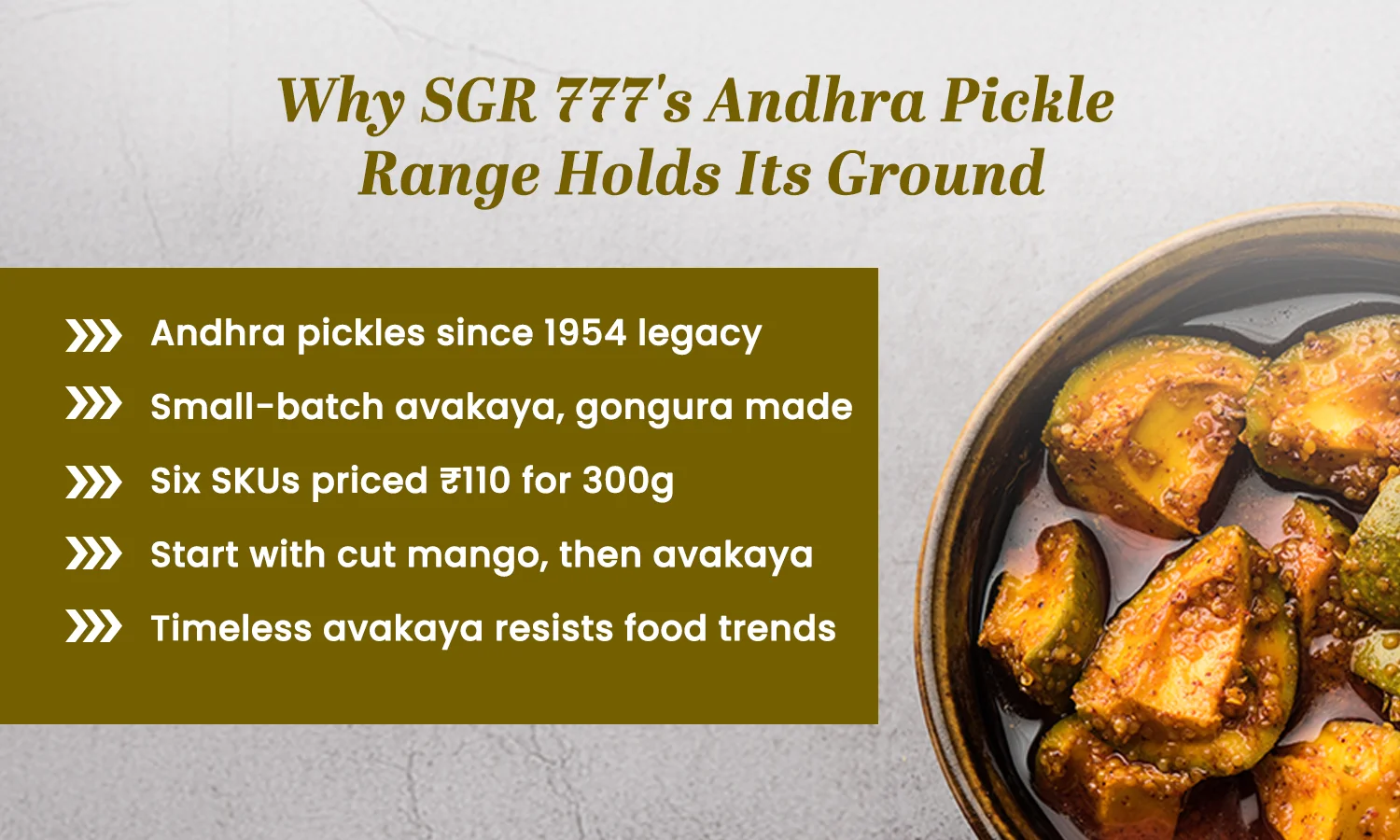
SGR 777 Foods has been making Andhra-style pickles since 1954 from a single kitchen in Mylapore, Chennai. The brand is among the shortlist that serious buyers mention when asked for the best Andhra pickles online, not because of marketing volume, but because it still produces avakaya, gongura, and cut mango in small, dated batches every summer. The Andhra pickle category here includes six flagship SKUs, each priced at ₹110 for 300g, which makes it competitive even against unorganised-sector alternatives.

For a first-time Andhra-pickle buyer, the recommended order of exploration is: start with cut mango pickle, graduate to avakaya, then branch to gongura and usirikaya. That sequence introduces heat, oil density, and sourness in controlled steps.

The Jar That Refuses to Go Out of Style

Every food trend of the last thirty years, low-salt, sugar-free, keto, air-fried, has tried and failed to displace avakaya. The reason is simple: there is no substitute for a condiment that has been perfected over five centuries.

Explore the SGR 777 pickle range and taste why some foods do not need updating.

FAQs :

What Is the Difference Between Avakaya Pickle and Avakkai Pickle?
None in substance, both refer to the same raw-mango-mustard-oil pickle from coastal Andhra. “Avakkai” is the Tamil transliteration; “avakaya” is the Telugu spelling. The recipe and sourcing are identical.
Is Avakaya Pickle Spicier Than Regular Mango Pickle?
Yes. Avakaya uses roughly twice the red chilli ratio of a standard mango pickle, and mustard is used split rather than ground. The heat is deliberate and designed to cut through ghee-rich meals.
How Long Does Andhra Avakaya Pickle Last?
Unopened and stored in a cool, dry place, 18 months. Opened and stored under its oil layer with dry-spoon use, 10–12 months at room temperature. Refrigeration extends this to 15–18 months.
What Makes Sgr 777’s Avakaya Different From Other Brands?
Single-season production, Guntur-origin chilli, chekku-pressed gingelly oil, split-seed mustard, and a 7-day mandatory maturation before dispatch. Combined, these align with how avakaya was made in homes before industrial shortcuts were introduced.

Recent Comments

No comments to show.

Recent Post

Cart

Create your account

Select the fields to be shown. Others will be hidden. Drag and drop to rearrange the order.
  • Image
  • SKU
  • Rating
  • Price
  • Stock
  • Availability
  • Add to cart
  • Description
  • Content
  • Weight
  • Dimensions
  • Additional information
Click outside to hide the comparison bar
Compare